Cyberdecks, Going Analog, Permacomputing, Medieval Guilds, and the Arts and Crafts Movement
People are moving away from corporate controlled tech, and making their own. How the designs of cyberdecks are being driven by women. And how medieval guilds, Luddites, and the Arts and Crafts movement are all connected to our current moment.

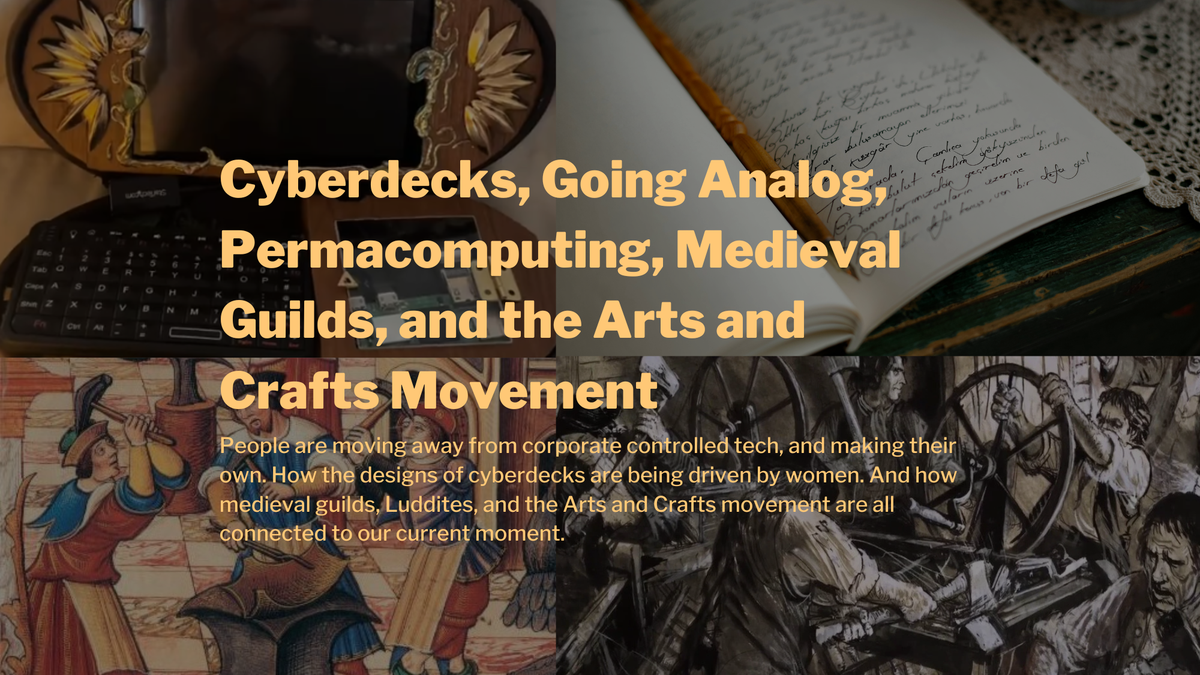
Within the algorithmic bubbles beneath the surface of the internet, there is a growing wave of people who are opting out of social media, opting out of technology, or simply opting out of the corpo-internet-techbubble hellscape.
As the internet flattens into a few social media platforms, with their bland - smooth - optimized - designs, we are losing the "color" of the internet. The corpo-internet-techbubble hellscape is something that you are already very familiar with. Everything feels the same, each platform copies features from their competitor, every one of the major social media platforms feels like they are created in a lab run by UI/UX designers who are desperately trying to keep you in an algorithmic prison by getting you addicted to the gambling machine that is the infinite feed. Many people have talked about this, the enshittification of the internet (and arguably everything around us), the flattening of not only aesthetics but also cultural reproduction.
There is an interesting breeze that's blowing through in certain corners of the internet at the moment. What feels like subtle shifts away from our computers and phones, and towards things we seemingly left in the past. But at the same time, an outlook on technology that both reaches into the past, and looks forward to a different future.
The things we left behind. The things we forgot. The things we miss.
We have forgotten what it means to be bored. We have forgotten what reality feels like when we aren't connected to the tendrils of a machine injecting dopamine directly into our brains - every second of every day. Our brains are collectively being stimulated around the clock. Perpetually plugged into the streams of information, videos, and notifications.
At all times, we can distract ourselves from our emotions. We can distract ourselves waiting for the elevator. Distract ourselves using the bathroom. Standing in line waiting for food, the first instinct is to reach for our phones.
Technology was supposed to connect us, and yet, we are disconnected by the constant connections. It's in this disconnection, this isolation, this growing antagonism to the systems that surround us, that the seeds of change are being planted.
People are starting to unplug and are returning to things they left behind - or seemingly were left behind but were always there. This is apparent in the rise of "journal tok", where people on TikTok are posting about returning to written journals, planners, and sketchbooks.
All of this, however, is a contradiction in and of itself, because people are posting online about how they are moving parts of their lives offline. This contradiction is important (when talking about consumerism and trends), but it's also just an indication of the current time. In order to share information, you most likely will have to share it online - to a mass audience - outside of your local/physical space.
People are also starting to dust off their old MP3 players, or finding old ones in thrift stores, in direct opposition to music streaming platforms. Piracy is back in full force. Why pay a subscription to a music streaming platform that can change what they host at any moment? Why support a music streaming platform that doesn't even pay artists, when you can pirate the music? The idea of ownership has been eroded by corporations that rent the things we used to own back to us.
The rise of owning physical media (or pirating) is directly connected to people returning to physical journals, planners, and sketchbooks. Tangentally, and almost on the exact opposite spectrum, other people are embracing technology as a way to remove themselves from the corporate internet. But this embrace follows the same idea as the overarching return to physical media - but now it's about the return to an older thought process around computers and a more future-focused outlook that questions the trajectory of computing going forward. Computers that are personalized, built, and modified not just for their use, but for specific aesthetics, and for specific and personal reasons. That's why we are seeing another wave of resurgence with cyberdecks.
Cyberdecks are changing for the better
I say that cyberdecks are having another wave of resurgence because the interest in cyberdecks waxes and wanes, like everything in life, there is a cycle to the ideas coming into focus and out of focus, washing into the shore and washing back out to the sea of etheral thought.
In my own view, cyberdecks have remained popular because of hacker culture. And all of the cultural norms wrapped up in hacker subcultures carries along with it. Specifically, the design of cyberdecks over the years has maintained a steady state of projects that maintain a military or scientific bend to them. They are afterall, influenced by science fiction about dystopian future societies that focus on war, dystopian corporate megacities, or interstellar travel.
What is a cyberdeck
Jorvon Moss and his hand-built robot companion can explain it pretty well:
@jorvonmoss I made a small explanation video on what a cyberdeck is #maker #cyberpunk #robot
♬ That Couch Potato Again - Prod. By Rose
In terms of the history of the term, it originated from William Gibson's book Neuromancer, which is widely associated with the birth of the cyberpunk subgenre. Cyberdecks were originally thought of as small personal computers, mostly used by "console cowboys" who were skilled hackers living in a futuristic dystopian world. But these cyberdecks were customized and tailored based on the unique qualities of each person and were the way that people accessed cyberspace (this book coined that term), which was an early conception of the internet.
These aesthetics have stayed relatively the same, and you can see the general design vibe in this gallery.


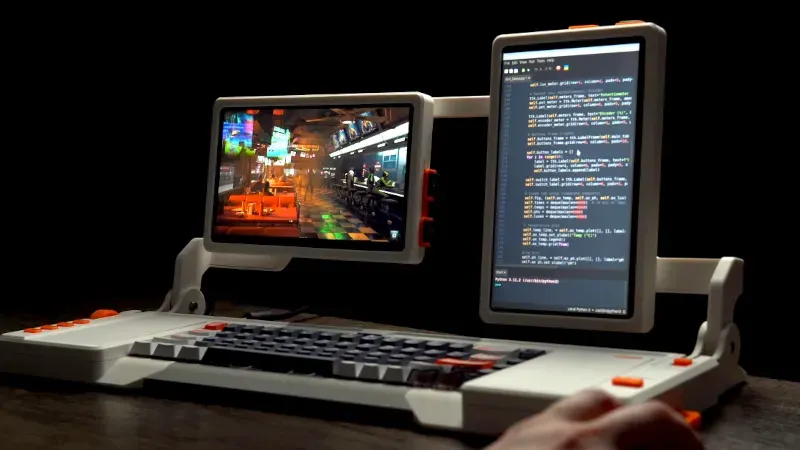
Most cyberdeck builds incorporate different small-scale manufacturing techniques using 3D printing, wood, or laser-cut metal parts that can be made in a home workshop. The key thing with cyberdeck designs is that they typically reuse parts from other objects. The first example is a common design. I just like how Justohl designed the internal parts and the face frame to sit nearly flush with the edge of the waterproof case. But you can see the general influence of military-esque design, or influences from what you might imagine on a spaceship.
If you have been wrapped up in hacker culture, or tech culture in general, at one point in time, you most likely would have wanted to build your own cyberdeck. But with this being a niche interest, cyberdecks haven't really captured the attention of people outside of specific subcultures. But I feel like this is quickly changing.
Cyberdeck Renaissance
At the moment, I'm seeing an explosion of videos on social media about cyberdecks. But these videos aren't coming from the usual hacker//tech enthusiast//nerd circles where cyberdecks are pretty common. But now, it's spreading outside of those circles, and there is a growing embrace of different aesthetics. Sure, the people really spearheading this new wave are tech enthusiasts, but the design choices are becoming more varied, deeper, and I would argue even more personalized.
As with many innovations, these changes are coming from marginalized people. Specifically, women, non-binary people, the trans community, and people of color.
The creator Ube Boobey I think kicked things off recently with their TikToks about creating a cyberdeck using a clutch purse as the shell of the cyberdeck.
@ubeboobey working on my first cyberdeck!! i have no previous experience with tech btw #cyberpunk #cyber #raspberrypi
♬ lilacs - azrxel & abxddon
Every day, I'm seeing new cyberdeck builds using upcycled and reused materials, from vintage storage boxes, purses, tool boxes, and other materials that are really pushing the design focus of cyberdecks in a whole new direction.
@ebonijazzmine_ Am I 👁️ entering my #cyberdeck arc?! #womeninstem #rasberrypi #trending ✨
♬ original sound - Eboni The Side Quest Princess
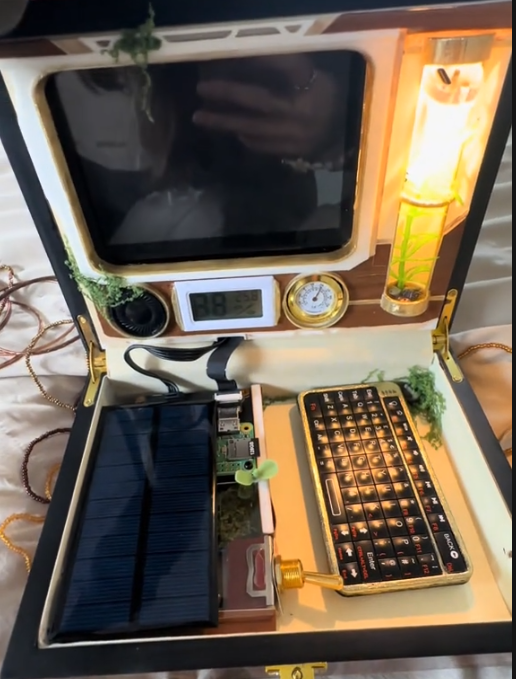
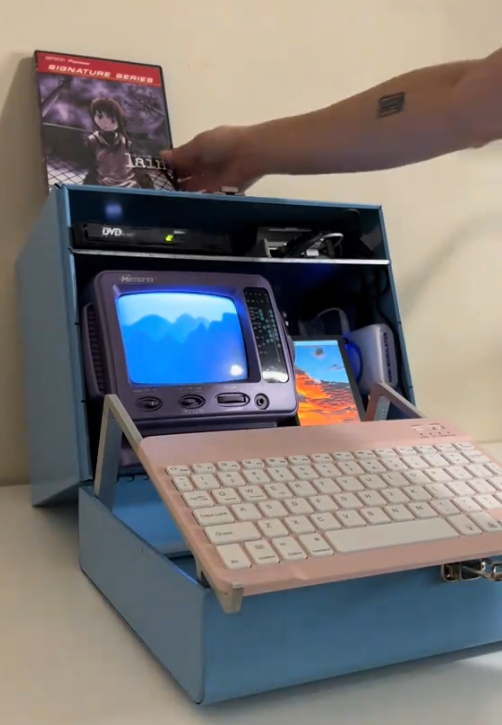
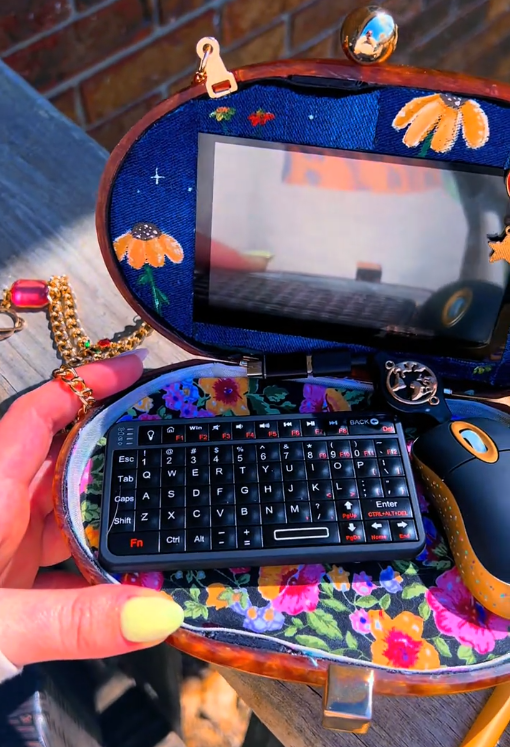
@ubeboobey - @serialexperiments404 - @caitlinjordan_
I hate the word "trend" to describe a cultural shift. Though for some people, all of this is a passing trend to follow, a phase to post about on social media, or another excuse to consume. This idea of disposable trends will be touched on later because it ties into the nature of social media in general. But I feel like there is a spark happening right now that could grow into a larger fire. I don't see this aesthetic and overall design shift as a passing phase, but the next evolution of cyberdecks. I see this as an indication of something larger, a general movement towards something new and old.
@vickieevicee made a great TikTok on the connection of women to this resurgence of cyberdecks and what that all has to do with solarpunk. (TikTok won't allow me to embed their video directly into this article - it's a setting in TikTok that has to be enabled) But I will add the direct link here to watch.
Women have always pushed computing to their limits. We wouldn't have computers without the work of Ada Lovelace, who came up with the basis of what is considered the first computer. We wouldn't have personal computers without Mary Allen Wilkes. And we wouldn't have spectrum hopping, which is the core tech behind wireless networking and Bluetooth, without Hedy Lamarr. Highly recommend checking out the CyberFeminism index and CyberFeminism in general to learn more.
What's old is new - What's new is old
The return of physical media, the rejection of an increasingly industrialized and automated society, people taking their ideas and life back to paper journals, and the rejuvenation of cyberdecks are all connected to our current situation, our current world, and our current conditions. But. At the same time, it's a continuation of cycles that we have seen in the past.
Artificial Intelligence/Modern Capitalism | The Industrial Revolution | The Middle Ages
Our modern times mirror our history. Both today and during the Industrial Revolution, there existed veins of society that rejected the conditions of the time.
Technology being used as a driver solely for profit. Regardless of the impacts on humanity, society at large, or the environmental damage that this reckless profit-seeking causes.
Every trade and vocation being automated, people losing their livelihoods to automated machines that can do the work of ten people - but produce flat and easily reproducible commodities instead of things that had a personal touch, that were made with care. Replacing the training and expertise of people who had spent decades, or sometimes their entire lives, mastering their craft.
Cities and rural areas being poisoned by the pollution of these industrial machines. Mass unemployment. Huge gaps in wealth between the rich and the working class.
We have been here before and have repeated the cycle since the Middle Ages.
The commons were taken away, walled, and gated off. Workers' guilds were dissolved, and the craftsmen were pushed into drudgery. Work was in service to a Lord; work was in service to the wealthy oligarchs who seized control of the commons and created their own kingdoms.
A thousand kings in the shells of broken countries. Large swaths of people under the control and mercy of a "king" who decided they had a divine right to rule purely based on their own self-aggrandizing delusions.
The lords who do their king's bidding control housing, control agriculture, control commerce, and determine the lives and flows of the common people. Where they can travel, when they can travel, how much of their labor is stolen from them in the form of taxes, levies, and offerings.
A permanent underclass of serfs. Serfs who do the work to keep kingdoms running. Serfs who tend to the fields, who produce the goods, who raise the livestock, who run the economy. Perpetually kept in line by private armies who are beholdant to the wealthy. Serfs who, in order to live, need to work to provide an income, to afford housing, to eat, to obtain the basic necessities of survival.
Serfs who are pushed slowly to their deaths in the service of a small group of wealthy people who own the land, who own the factories and workshops, who own every business, and who own every home.
Forests were clear-cut in the pursuit of profit. Rivers were poisoned and drained to feed the system of production. Waste was dumped in sensitive ecosystems. Animals were driven to extinction for trade, or for land, or because their homes were destroyed by industrialization.
The Middle Ages, the Industrial Revolution, and our current Techno-Fudalist time are all connected. We still have lords (land lords, the bourgeoisie), we still have kings who enclose the commons (billionaires who enclosed the commons of the internet), who enforce violence with the hand of private armies of knights (the police and military), who demand that we provide for them while they subjugate us.
Medieval Guilds & The Arts and Crafts movement
Medieval guilds were created during feudal times as a challenge to the labor exploitation of the working class of the time. In some areas, guilds were organized by specific crafts. Metalsmithing, woodworking, and textiles are some examples. Guilds had specific guidelines on quality, and they created widespread quality control over the goods produced by the artisans in the guild. If a woodworker produced bad-quality furniture, their guild could basically force them to remake it to their quality standards.
Guilds were basically worker cooperatives (in some cases) or could be thought of as trade-specific labor unions, though their inner workings were far less democratic compared to than modern labor unions. Guilds acted like unions in that they had members who ran the Guild, they provided jobs and training to apprentices to learn specific trades, and they would often offer room and board for people learning a craft until they became proficient enough to work on their own, and pay their dues back to the guild. But most importantly, they provided a safety net in their collective approach to production that directly fought against the exploitation of the working class by the wealthy. If you wanted something made, you had to go through a guild. The guilds set prices based on the opinions of their members. The people who were making the goods determined how, where, and how much their goods were being sold for. (There were also merchant guilds that controlled the trade of finished goods, but they were basically unions of drop shippers.)
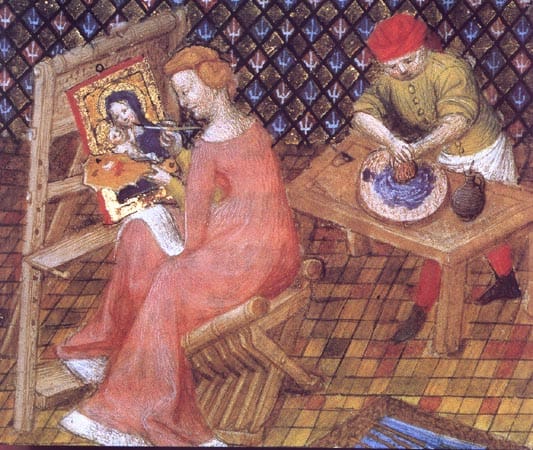
At most points, guilds created a monopoly on labor and manufacturing. There was also extreme inequality within guilds that led to a permanent underclass of unpaid apprentices and inequality when it came to people who were not members of guilds. This was actually critiqued by Karl Marx, and these critiques of early trade unions were directly used when worker assemblies (soviets in Russian) were starting to form before the Soviet Revolution of 1917.
The guild system began to die as capitalism took hold in the 16th century. Adam Smith, known as the "father of economics," viewed guilds as a roadblock to economic competition, a blight that lowered profits and led to inflated prices, and thought that guilds stifled the innovations of capitalism by gatekeeping production. Guilds went away basically because the wealthy were tired of dealing with working-class people who had collectivized and were essentially killed by what could be thought of today as union busting.
Luddites, The Arts and Crafts Movement, and the Battle Against Industrialization
As capitalism killed the worker guilds of Europe, it also produced the groundwork for the Industrial Revolution. Without widespread organized labor groups (they existed but were constantly being attacked), capitalists saw that they could mechanize and automate nearly all forms of industry. This automation would cut down on the number of humans needed to produce commodities. And so the Industrial Revolution began.
The Arts and Crafts movement took off between 1860 and 1915, but the early criticisms of industrialization, in my opinion, started with the Luddites. The criticisms and actions of the Luddites happened in the early 1800's, and I would argue lay a foundational basis to the design, manufacturing, and social outlook of the people that would later make up the Arts and Crafts movement.
Though the term "Luddite" is now used derogatorily to mean someone is opposed to all forms of technology. The Luddites were, by and large, concerned with the labor exploitation happening during the Industrial Revolution, and they were mainly against the use of automated machinery as a mechanism of replacing and dispossessing the working class and the artisans who created goods outside of these factories.
A huge part of the Luddite rebellion was to address the low wages, dangerous working conditions, and overall mistreatment of workers within factories. Another part of the equation was the relatively low quality of the goods being produced compared to those made by hand or by craftsmen who had trained for decades in their respective crafts.
The Luddites smashed textile looms and burnt factories. Not because they hated the technology itself, many of the people who took part in attacking factories were textile makers themselves, and who knew how to use the technology very well - but because they hated how the technology was being used to subjugate workers, how it was used to poison the environment, and how it was being used to undermine the skill and attention that went into creating things.
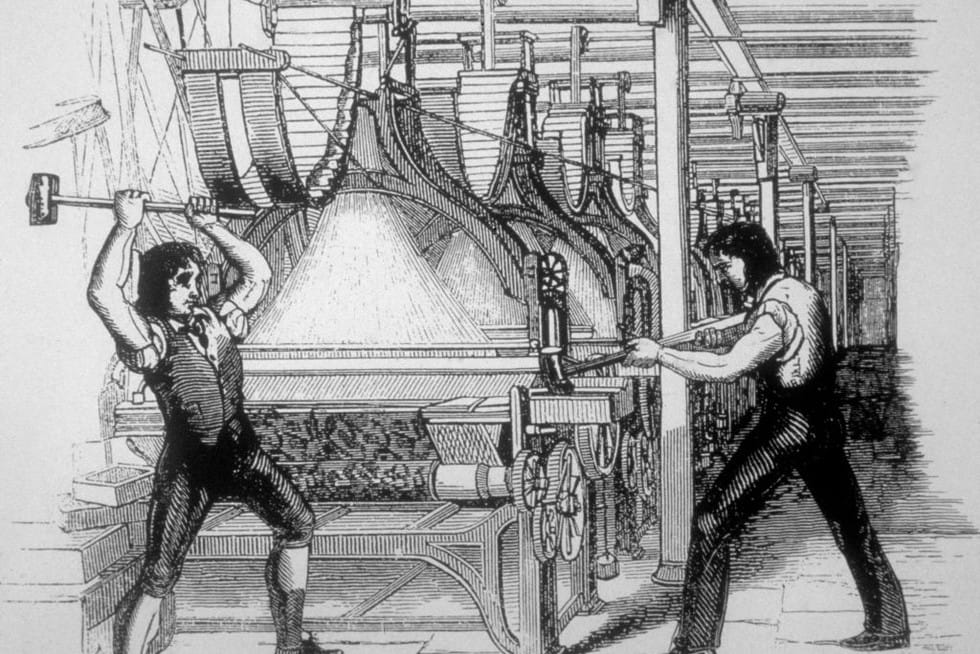
So we can see the thread of antagonism towards the misuse of technology woven into the ideas that the Arts and Crafts movement would pick up on.
John Ruskin and William Morris - Arts and Crafts
“It is not that men are ill fed, but that they have no pleasure in the work by which they make their bread, and therefore look to wealth as the only means of pleasure."
- John Ruskin, The Stones of Venice (Vol.2), Chapter 4. "The nature of Gothic"
John Ruskin plays a huge part in connecting the ideals of the Luddites to what would become the Arts and Crafts movement later on. Ruskin believed that industrial capitalism stripped workers of their humanity, that the system of capitalism stole the most important hours of people's lives, and deprived them of a true form of life because they were forced to work constantly, and under dangerous and unsanitary conditions. During this industrial time, workers got no pleasure or happiness working on an assembly line. They didn't develop the skills of the craftsman when it came to producing personalized crafts. They showed up to work, worked for twelve hours, went home to sleep, and did it all again.
Ruskin also believed that aesthetics and art were the pillars of producing culture. And that industrialization and the standardization that came with automated manufacturing took the mechanisms of producing culture away from people and societies at large. Aesthetics drive the outlooks of people; they evoke emotions sometimes better than words. Art and creativity have been a cornerstone of humanity throughout all of human history. Before humans were writing, we were creating, drawing, painting, and crafting. And like many other contemporaries of his time, Ruskin's philosophical outlook pointed out that people cannot live fulfilling lives if all of their time is spent making money to survive.
William Morris
William Morris was inspired by John Ruskin's ideals, and combined his own experiences, thoughts, and philosophies to create the foundation for the Arts and Crafts movement. William Morris republished John Ruskin's work "The Nature of Gothic" in 1892 and in the preface said:
"Ruskin's ideas were ... one of the very few necessary and inevitable utterances of the century... To some of us when we first read it, now many years ago, it seemed to point out a new road on which the world should travel."
William Morris built on the ideas shared between John Ruskin and the Luddites and added political philosophy inspired by social and communist thinkers of his time. He also harkened back to the medieval guild approach to crafts - that making things should be a pleasure. That making things should be, in and of itself, a form of art. And that art was not only the forms of "high art" that dominated the conception of the arts at that time, but art should encompass all crafts, woodworking, metal working, basketry, textiles, should be on equal standing with oil painting and what was widely considered "fine art".
Morris' pivotal speculative work "News from Nowhere" highlights how he thought about the world at the time by imagining a different future. In the book, the main character wakes up in the future in a post-revolutionary society. A society where there is no private property, money, class, or prisons. In this world, people live in harmony with the natural world, and "work" isn't work at all, but just a process of creativity.
William Morris, like the Luddites, did not hate all technology. But hated the fact that technology, when in the hands of the wrong people, could be used to exploit both humanity and the natural world. His main critique was that industrialization didn't make things that mattered. That industrialization cranked out products with the lowest quality possible to maximize profit. That the cookie-cutter production process cut out real artistic expression. That industrialized work killed the time and energy required to live a good life.
But the changes required to make industrialized work better would not come from changing the machines themselves. Improving the lives of workers wouldn't just mean giving them a slight raise. Morris believed that the changes would need to happen at the societal level, that we would need both a social and economic revolution to truly change work, and to truly come back to a world where crafts made a difference.
Going Analog and the New Arts and Crafts Movement
We come back to the modern world. Currently, we live in an economic and social system closer to that of medieval Europe, only a Technofudalist world.
The same grievances from medieval guilds, to the Luddites, to John Ruskin, to William Morris, to the Arts and Crafts movement, to our modern day are all connected.
They lived in, and we still live in a world of mass industrialization. Automation (now in our times, AI) is being used to disenfranchise the working class. We have lords who rule the land, both in the form of individuals (billionaires) who own large portions of land and large real estate corporations (like BlackRock) that own a massive amount of farmland and homes. We are overworked to the point of exhaustion, and that is the point. Because exhausted people can't think, they can't imagine; all they can do is survive. We are forced into the drudgery of daily survival, with added expectations to look after ourselves, or look after kids, to work out, to maintain a social life, all of the day-to-day expectations of life. We are also underpaid, with our wages being stolen by the people who own the means of production. We work to produce profits for people who didn't do the work themselves and are expected to just put up with it. We generate millions of dollars of net income for businesses and corporations, and yet we only see a fraction of what we produce. Our societies run on the idea that there are infinite resources to exploit. Our societies look at the natural world as a resource, with a dollar sign attached to each tree, each river, each living being.
All the while, technology has only advanced as the years go on. The commons have been seized again and again, and when we discover a new commons, like the internet, it too is enclosed.
I talk at length about the early internet, how cyberpunk was a direct response to capitalism and the rise of neoliberalism, hacker culture, and where we can go from here in this article:
 HydroponicTrash
The rise and existence of generative AI created the push back to analog. Like William Morris, we are tired of everything being standardized. We are tired of the sheen of AI, tired of looking at images produced by computers. Tired of looking at "art" produced by a machine. We want reality. We want real creativity. We want to appreciate the craft of an artist, listen to music created by people who are expressing their emotion and not soulless AI prompts. We want to return back to reality.
We want to escape the algorithmic plantations that tech companies have herded us into. We want real community, outside of the internet, while also maintaining connections with people across the world. We yearn for something real, something tangible. We yearn for real connection, real feeling, in what seems like an artificial world.
People are returning to physical journals because of the "industrialization" of the internet, returning to physical journals because we don't want to see advertisements while trying to organize our life. People are returning to physical media, because they are tired of streaming platforms removing content that they paid for, or modifying the content, or putting twenty advertisements in a movie.
People are tired of the algorithm, tired of sanitized technology. And so now, we are opting to care about the handmade, opting to care about the human touch. We are opting to care about the authentic, the real, the tangible.
Trends, Commodification, Consumption, and Co-optation
I don't think the resurgence of cyberdecks, and the new approaches to them, are going to be a fleeting trend. But they can be made into one. No matter what, capitalism will try to co-opt anything it can get its hands on. I think we need to be very wary about not only the design choices going forward, but also the material cost, and question the environmental and social impacts these decisions will make.
Capitalist Co-optation
I write at length about Solarpunk, 1960's counterculture, and new forms of social politics in this article.
 HydroponicTrash
There is a portion in it where I talk about some points that I think we can use to stop co-optation by companies to capitalize on the push towards the real.
Inoculations to Capitalist Co-opting (Click the arrow to expand)
- Avoid creations of hard in-groups and outgroups on trivial differences. The creation of strict subcultures allows for movement capture because it’s easier to pin down specific groups. By trivial differences, I mean very minute ones; there needs to be general guidelines on things (see the issues with big tent politics). But also, it can’t be ultra exclusionary. This is a hard balance to achiev,e but remember to keep your morals.
- Foster an aesthetic rooted in DIY and upcycled things, not commodities. Usually, there is an early attempt for capitalists to copy the style of a specific group or movement, or even try to put a specific style or way of looking that gets reabsorbed into the group. Make it so it’s impossible for them to sell anything.
- Morphing and changing throws off their trend cycles Embracing the weird, acid part of acid communism would mean not keeping things in a fixed idea of things. Keep things fluid and changing, just like experimental art. Capitalists will always be two steps behind as they try to keep up.
- Attack structures and ideas, not people. Don’t be a dick to people if they disagree with things(except Nazis and fascists, fuck ‘em). Only deal with the disagreements with the substance they are talking about. Attacking people isn’t productive, and oftentimes you will be able to find common ground outside of the knee-jerk reaction to you. “Be ruthless with systems; be kind to people.” - Michael Brooks
- Make things hostile for marketing. The worst thing for a marketer is for them to try to make a niche space into a market, and everyone in that space rejects the entire idea. Spotting companies setting up their tendrils into something, calling it out, and making the landscape impossible for them to sell anything.
- Foster anti-capitalist social arrangements. Wherever possible, try to make exchange deal less and less with money and capital exchange. Basing your actions on mutual aid in all things will cut down on the expectation that money will, or is required to, exchange hands. Though we do live in capitalism and there are times when money will exchange, maintaining that monetary exchange is not the only important thing will make sure that people can just do things for others and that there are more incentives to life than monetary exchange.
- Parody their messaging if capitalists do stereotype you. If there is a hyperreal personification or view a group, pointing out the contradictions in their personification can show people that their idea of things is twisted by capitalist stereotyping.
- Question who is running the platforms and outlets. A very common tactic to slip corporate interests into ideas is for them to become the funders and bedrock of communities. Always be asking who is running things and why. Not to a paranoid level, but be willing to question the motives of people or groups and their end goals.
Stop buying new shit, reuse whatever you can: Permacomputing in regards to cyberdecks
I've seen multiple comments, haul videos, and responses to some of these cyberdeck videos of people going out to purchase every single thing to make a cyberdeck in one fell swoop. But think about the ethos of cyberdecks. They were made by people living in a dystopia out of parts they had lying around or from reused/recycled components. Each one was unique to its creator.
Think about the materials going into your cyberdeck. A big one is the case. Please don't go out and buy a new case for your project. Reuse or upcycle something, turn one object into another. Save it from a landfill.
The components are harder to source if you are locked into a specific type of cyberdeck. Most people make them out of Raspberry Pi microcomputers. But you don't have to make a cyberdeck using a Raspberry Pi if you already have tech around you that you can reuse. Got an old laptop? Reuse it for something new. Found an old computer? Reuse it for something new.
Permacomputing and reusing technology
Care for All Hardware — Especially the Chips
Hardware has an environmental cost. There are rare earth minerals required to make even basic PCBs, and the resources that go into even a Raspberry Pi are incredible. All of the components required minerals to be mined, refined, shipped, manufactured, shipped again, assembled, shipped again. There is a long supply chain for technology.
If you are interested in revolutionary approaches to technology or solarpunk, look into permacomputing. https://permacomputing.net.
I specifically want to quote this section:
Caring for the planet also means caring for the material foundations of digital technology: our hardware. Every device, chip, and component originates from Earth’s finite resources—and eventually end up as e-waste.
The production of new hardware, especially microchips, which are at the heart of nearly every device we use, is highly resource-intensive and energy-consuming. Microchips are particularly problematic because they are difficult to recycle, cost an immense amount of energy and resources to manufacture and their production is highly polluting. Maximizing the lifespan of hardware components is critical for reducing environmental impact and promoting a more sustainable and less harmful digital culture.
One of the core principles of permaculture is to "produce no waste," encouraging us to value and reuse all resources at hand, turning waste into a resource whenever possible.
Digital technology cannot be produced without waste. To mitigate this situation, this principle calls us to step outside the capitalist model of perpetual consumption and growth. Instead, it invites us to recognize the inherent value of the devices, components, and materials we already have—and to care for them intentionally. Caring for the planet also means caring for the material foundations of digital technology: our hardware. Every chip and component is made from Earth’s finite resources, and once discarded, becomes part of the growing e-waste crisis. By acknowledging that these devices are not self-sustaining, we underscore the importance of extending their lifespan through intentional maintenance and thoughtful use.
If we want to change our socioeconomic systems, we have to change our culture, we have to change our collective thoughts about technology and ecology.
Tying it all together
We can see that what feels new to us is actually an old cycle that has repeated throughout time. Will we break the cycle?
Technology has been both an antagonistic force, and a way of opening up completely different realities. It's all about how, why, and when we use technology.
Breaking the cycle will mean thinking past how things affect us. And thinking about how the way we design, build, and create can impact our environment around us.
We are returning to the human, to the handmade, embracing creativity. But to make that happen at scale, we need to fundamentally rethink our social and economic systems.
We need to collectivize our creativity like the medieval guilds. We need to smash the machines of exploitation like the Luddites. We need to create economic systems that don't focus on profit, and instead focus on human flourishing. Work shouldn't be drudgery just to earn enough money to survive. Our days should be spent creating - with each other - on equal terms. We need to imagine a better future and do everything we can to lay the groundwork for change, even if it's just imagining something new. We need to take things destined for the landfill and give them new life.
We can create art, we can create something new.